Work in progress

Thumbnail for Minting Words: Why Central Banks Develop CBDCs

Minting Words: Why Central Banks Develop CBDCs

with Léo Malherbe
Abstract
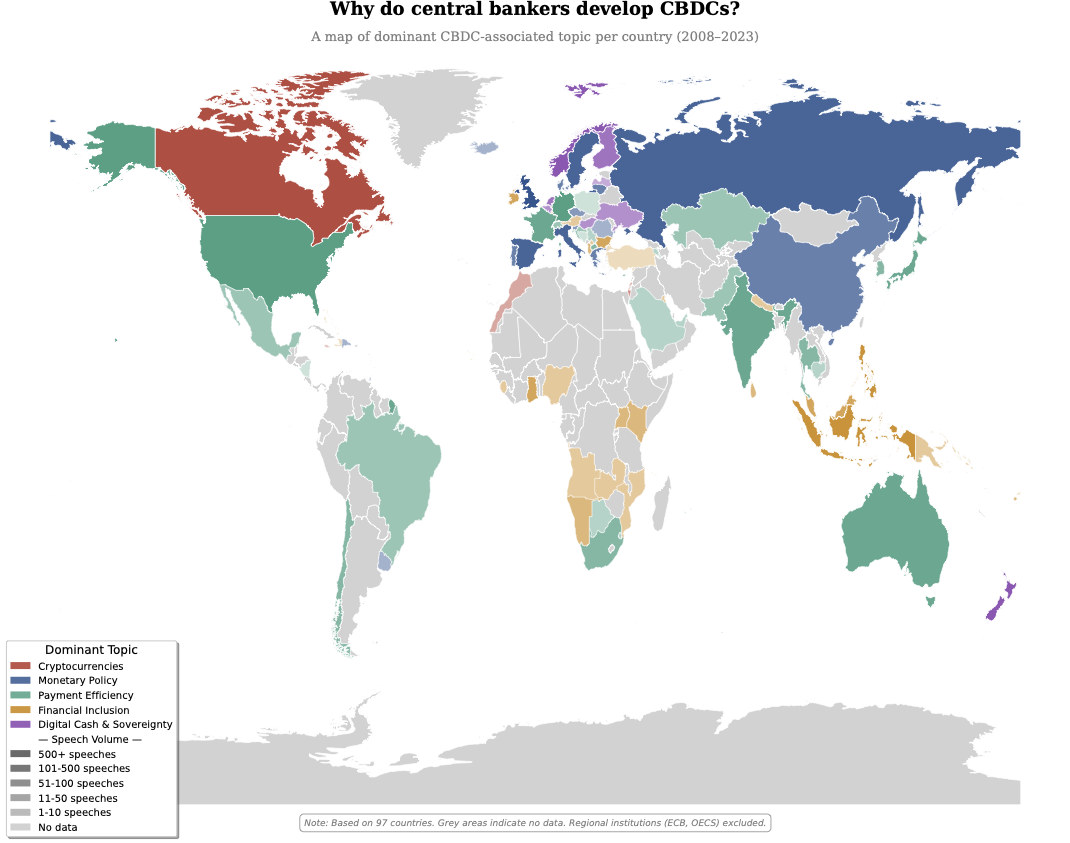
With L. Malherbe (UPJV) Central bank digital currencies (CBDCs) have moved rapidly from a niche policy discussion to a central issue in contemporary monetary policy. Yet the speed and unevenness of CBDC development remain puzzling, especially since central banks are typically cautious institutions facing political, reputational, and institutional constraints. This paper studies why central banks develop CBDCs by examining how they communicate about them. We assemble a new cross-country corpus of 1,390 CBDC-related speeches from 94 central banks over 2013 to 2023, yielding 8,129 sentence-level mentions. Using a transformer-based topic model, we identify 31 topics and group them into five broader motivations: responses to cryptocurrencies and private digital currencies, financial inclusion, monetary policy, payment systems, and project management. We then estimate how institutional, political, and regulatory conditions shape the likelihood that each motivation is emphasized in central bank communication. We extend the analysis by linking these communication patterns to countries’ stages of CBDC advancement, using CBDC Tracker data to study the mechanisms through which stated motivations translate into policy progress.
Thumbnail for What Drives Monetary Preferences? Evidence from MEPs' Social Media Discourse on Cryptocurrencies and the Digital Euro

What Drives Monetary Preferences? Evidence from MEPs' Social Media Discourse on Cryptocurrencies and the Digital Euro

Abstract
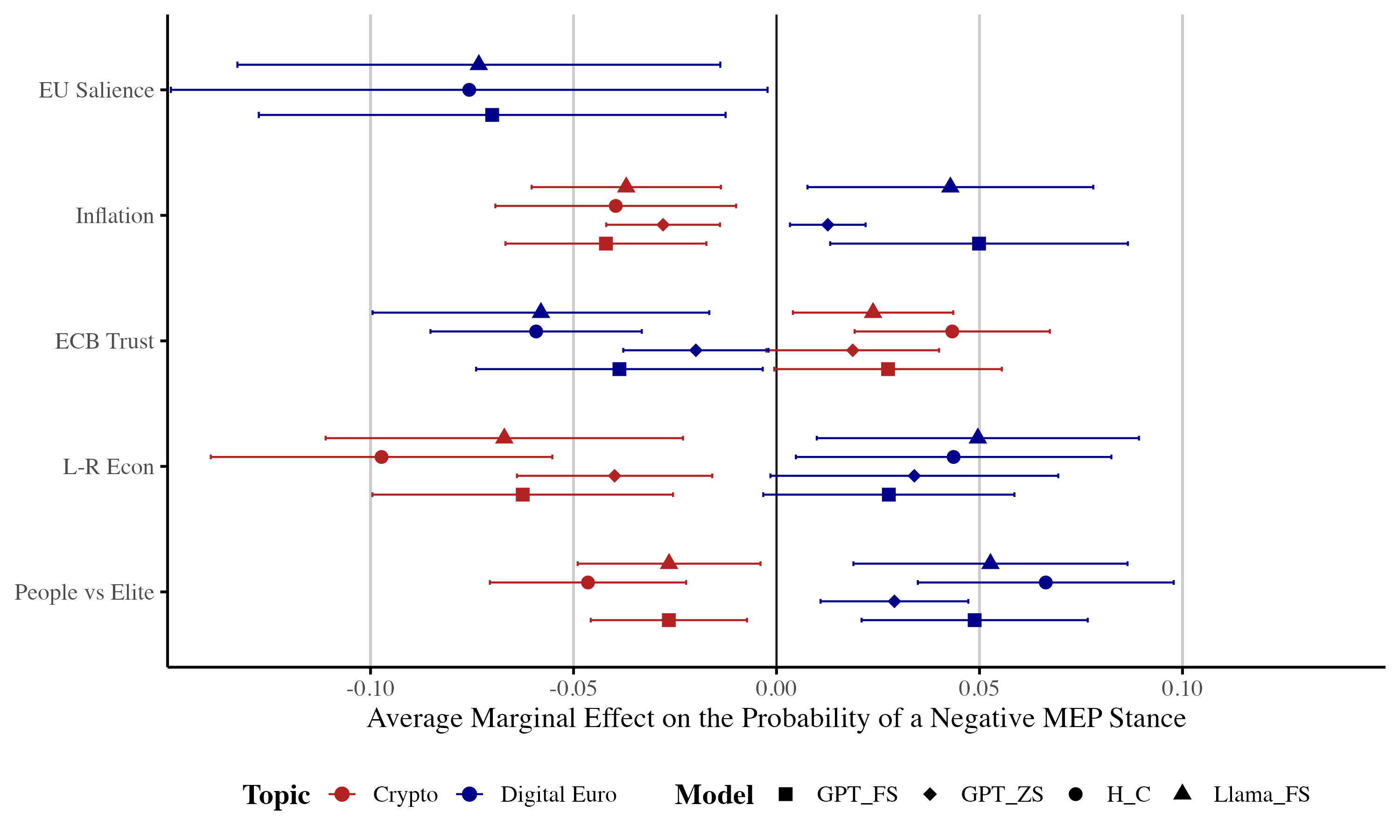
This paper studies how ideology and economic conditions shape political preferences over digital money in the European Parliament. During the 9th Legislature, debates on cryptocurrency regulation and the ECB’s central bank digital currency—the digital euro—created a rare opportunity to observe the politicization of money and assess whether it generates political polarization. Drawing on 2,523 tweets from 224 MEPs, we combine sentiment analysis with an unsupervised text-scaling model to identify the ideological and economic determinants of support for private and public digital money, to trace how these preferences are connected, and through which mechanisms. We document a mirror-image pattern: anti-elitism, right-wing economic positioning, and exposure to inflation increase support for cryptocurrencies, while the same drivers underpin opposition to the digital euro. The text-scaling analysis shows that discourse polarizes around privacy and fears of ECB mandate expansion, raising broader concerns about the political acceptability of the digital euro. Taken together, the findings indicate that debates over ECB legitimacy have crystallized into a new cleavage opposing public and private digital money. Under review – Working paper available below

Published papers

Thumbnail for Metaverse and AI diffusion: an empirical assessment from a financial perspective

Metaverse and AI diffusion: an empirical assessment from a financial perspective

with Morgane Ramis
Published in IEEE Engineering Management Review DOI
Abstract
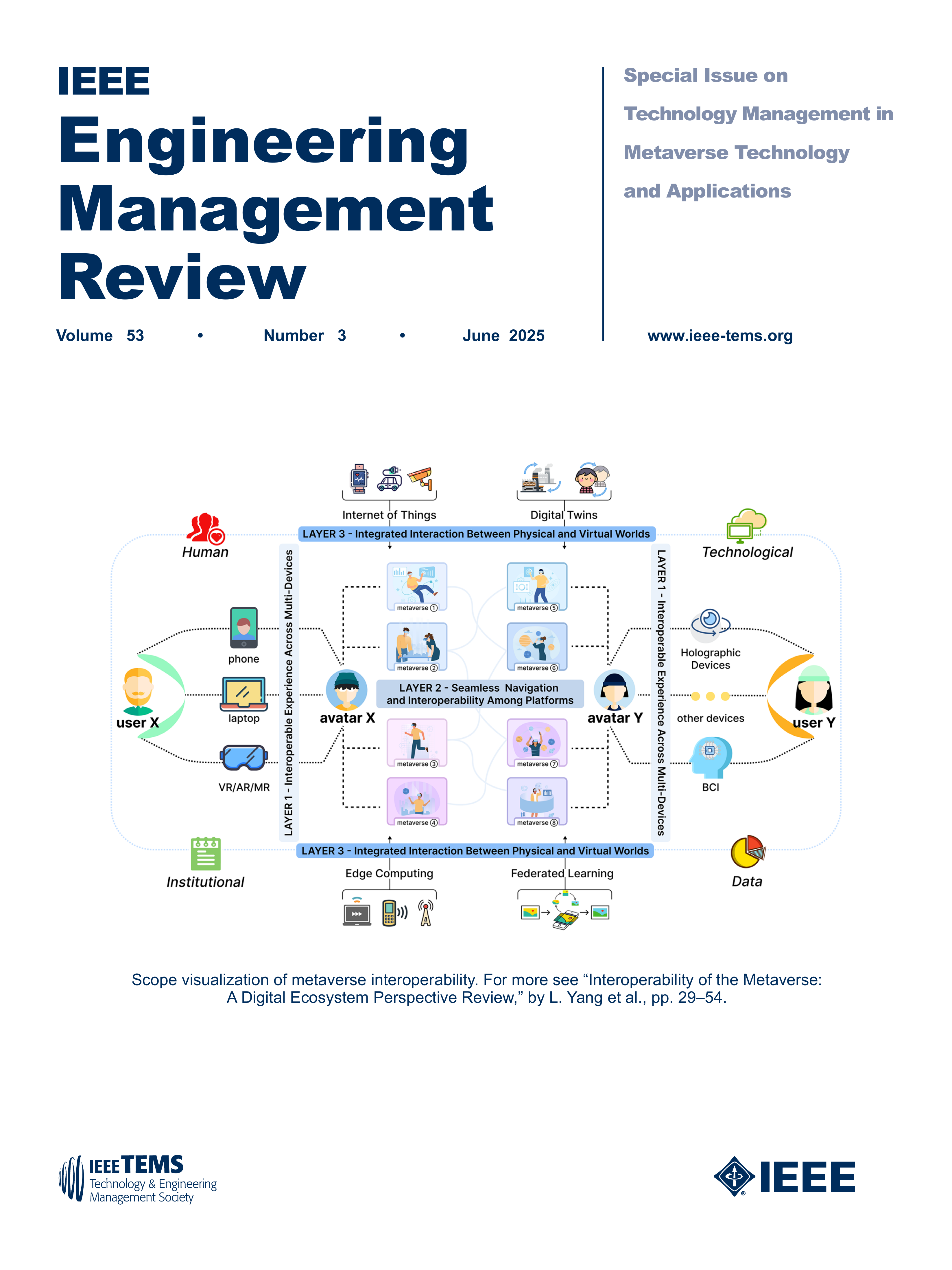
The metaverse has gained popularity in recent years but remains technically nascent. Theoretical literature highlights the key role of artificial intelligence (AI) in metaverse development, as AI is expected to bolster the creator economy, a key pillar of these platforms’ success. However, no empirical work confirms this expectation yet. To address this gap, we constructed two proxies—protometaverses and traditional video games—to isolate financial transactions specific to the metaverse toward AI from general trends in the gaming sector. We present empirical evidence from Crunchbase data on acquisitions and investments, confirming AIs role as a catalyst for metaverse development. Our analysis reveals that protometaverses are more likely than traditional video games to invest in and acquire AI startups controlling for several factors. In addition, we examine the specific types of AI targeted in these financial transactions and integrate the findings into a theoretical framework that highlights the structural specificities of AI applications in metaverses, distinguishing them from those in traditional video games. Finally, the results give credit to protometaverses as a relevant proxy for metaverse evolution, with a replicable categorization. This article contributes an empirical foundation to the theoretical literature on the subject, explaining it through an analytical framework that connects the economics of innovation and network effects. Moreover, we highlight specific implications for practitioners and policymakers in the metaverse industry.
Thumbnail for Théoriser les cryptomonnaies: un mirage hayékien?

Théoriser les cryptomonnaies: un mirage hayékien?

Published in [french] Book chapter - Regards croisés sur Hayek DOI
Abstract
L’engouement suscité par Bitcoin semble avoir donné un regain de souffle em- pirique à la proposition de concurrence entre monnaies privées défendue par Friedrich Hayek. A partir d’archives situées à la confluence de l’économie et des sciences informatiques, nous mettons en évidence une inspiration hayékienne explicite dans les réseaux militants ayant per- mis l’émergence de Bitcoin. Pourtant, cette filiation semble s’apparenter davantage à une jus- tification théorique ex post qu’à l’application fidèle des perspectives monétaires hayékiennes. En effet, (i) Bitcoin élimine les coûts de la confiance envers les intermédiaires par la rigidité technique, là où Hayek préconisait de déplacer la confiance vers la concurrence de marché. Bitcoin adopte ainsi (ii) une règle d’or monétaire, à rebours de l’endogénéité souhaitée par Hayek, pour qui l’offre de monnaie doit demeurer flexible. A l’instar de l’étalon-or, cela im- plique pour Bitcoin une sensibilité élevée aux chocs de demande : (iii) en confondant valeur et pouvoir d’achat, Bitcoin ferait primer le motif de thésaurisation au détriment du motif transactionnel, fonction pourtant la plus importante chez l’économiste Autrichien. Enfin, nous proposons une analyse du marché cryptomonétaire à l’aune des propriétés de la concur- rence monétaire hayékienne, éliminant les « mauvaises monnaies » au profit des plus dignes de confiance.